

A little background on me for those who don’t know — I’m a Supply Chain executive by trade, so I tend to keep a close pulse on any market I’m personally involved in (ingredients, freight, warehousing, etc). I also tend to do business with really good companies and spend a lot of time analyzing the partners I decide to work with.
PTRN is one of those companies, which is why I invested in them on their IPO day. Samsara is another one where I’ve personally seen their new tech and it’s pretty remarkable, and solves a real issue that has lived within supply chain’s and that is visibility, at an affordable cost.
The Tracking Label
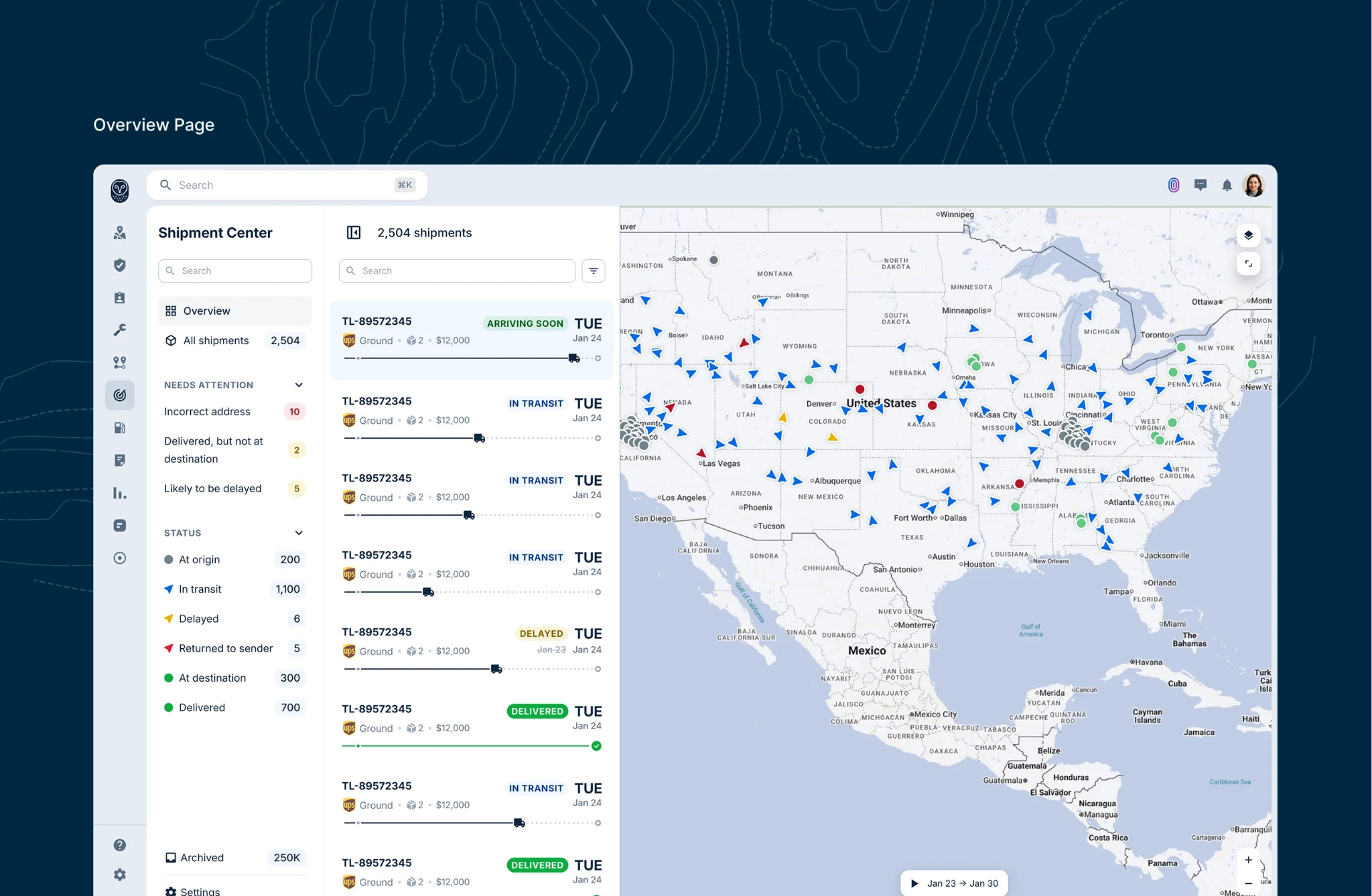
Here’s the product: a paper-thin, adhesive-backed, single-use Bluetooth label with a 45-day battery. No lithium, no hazmat, which means it’s cleared for air, ground, and rail, and you throw it away when the shipment lands. Slap it on a box or a pallet, activate it with one scan of the BOL in their app, done.
The clever part isn’t the label. It’s the network behind it. The label itself has no cellular connection. Instead, it gets picked up by the Samsara Network: millions of Samsara-connected devices already out in the world (trucks, trailers, warehouse scanners, phones) covering 99% of major U.S. roads. Every Samsara-equipped vehicle that drives past your shipment becomes a listening post. If you’ve used an Apple AirTag, it’s the same playbook. Apple’s Find My network works because there are a billion iPhones out there. Samsara spent a decade building the freight equivalent, and the Tracking Label is how they monetize it.
The problem this solves is one anyone in supply chain knows intimately: once freight leaves your dock on an LTL or truckload carrier, it goes dark. You get two data points, picked up and delivered, and everything in between is a prayer and a check-call. Meanwhile cargo theft is running roughly $35 billion a year in the U.S., up 60% year over year. The existing answers all have a fatal flaw. Cellular trackers are too expensive to put on everything, RFID only works where someone installed readers, and carrier tracking data is milestone-based garbage. A disposable label that rides a pre-built network kills all three problems at once.
Valuation and upside
IOT trades around $36 with a ~$21B market cap, against FY2027 revenue guidance of roughly $2.0B. Call it ~10x forward sales. Last quarter they beat on both lines: revenue of $478.8M, up 30.5% YoY, with EPS of $0.17 vs. $0.13 expected. Gross margins run in the mid-70s and they’re free-cash-flow positive. So you’re paying a premium software multiple, but for a rare profile: durable ~30% growth, sticky multi-year contracts (~98% of revenue is recurring subscription), and a physical installed base competitors can’t replicate with code.
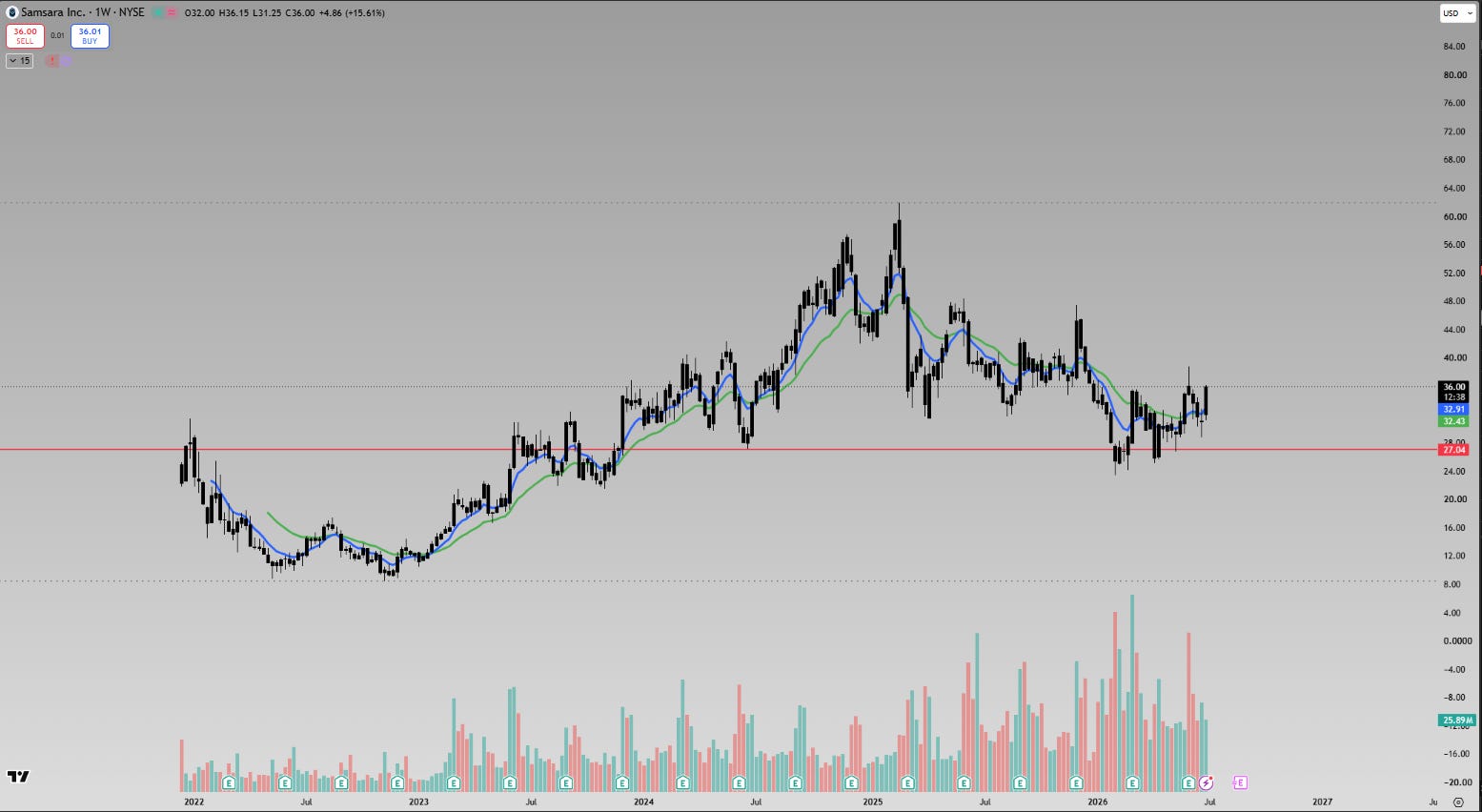
My simple framework: if they compound revenue at 25% for three years, that’s roughly $3.9 to $4B in revenue by FY2030. Hold the multiple at 10x and you’re looking at a ~$40B company, about a double. Even in a de-rating scenario where the multiple compresses to 7x, growth alone gets you to ~$27B, or ~35% upside. The bear case is deceleration below 20% plus multiple compression, which is real risk at this valuation. The stock’s 52-week range is $23 to $47, so the market has already priced both stories in the past year.
What the model doesn’t capture yet is the Tracking Label itself. Samsara’s core business sells subscriptions on durable hardware. The label is a consumable. Every shipment burns one. If this lands even modestly across their existing base of freight customers, it’s a recurring revenue stream layered on top of the subscription business, sold into accounts they already own. That optionality is what got me to size the position now rather than wait.
From a pure technical standpoint, we see it backfilled and held well against IPO highs, and is now climbing higher. This looks like a ~3 year consolidation getting ready to push higher in my opinion:
The bottleneck Samsara solves, at a fraction of the cost
The shipment visibility market has been “solved” three times, badly. Cellular GPS trackers work but cost real money per unit, need charging, and require reverse logistics to get the device back. So companies only tag their most critical freight and fly blind on the rest. RFID is cheap per tag but useless without reader infrastructure at every chokepoint, which is why adoption stalled. And the software visibility platforms are only as good as the carrier data feeding them: milestone pings, not location.
The industry’s actual constraint was never the sensor, it was the network. Per 451 Research, over half the market absorbs higher hardware costs on GPS/cellular just to guarantee coverage, while cheaper Bluetooth alternatives sat at ~39% adoption because the infrastructure was fragmented. Samsara didn’t have to build that infrastructure for this product. It was a byproduct of a decade of selling telematics. That’s the moat: a competitor can copy the label in a quarter; they can’t copy the millions of listening devices already on the road.
Samsara hasn't published list pricing, but their CEO has said labels will run in the single-digit dollars depending on volume. For context, a cellular tracker is a $100+ device that needs charging, a return trip, and its own data plan. Even generously assuming you reuse one across dozens of shipments, you're still managing a fleet of hardware. At a few bucks a label, the math flips: you stop asking "which shipments are worth tracking" and start asking "why wouldn't I tag everything over $X in value." That reframing is the whole product.
Trade Structures to Consider outside of just long commons:
Grabbed shares today for long term portfolio but here are a few other considerations:
Put ratio spread (1x2):
Buy 1x Jan '27 $32 put, sell 2x $28 puts, structured for a net credit. Three outcomes: stock stays above $32 → keep the credit; stock lands between $28-32 at expiry → the long put pays off on top of the credit (max profit at $28); stock craters through $28 → you're net short one put and get assigned around an effective basis of roughly $24-25 (strike minus spread value minus credit). It's the most "paid to buy the dip" structure of the group, but it's also the most path-sensitive and the ugliest mark-to-market in a fast selloff since the naked short put gamma bites hardest exactly when the tape is worst.
Risk reversal (sell put + buy call) - probably the best fit for my actual view
Sell the Jan '27 ~$28-30 put, use the premium to finance the Jan '27 ~$40-42 call. Can branch this out to 2028 expiry if the spreads make sense (may be a bit wide). Goal being to get near zero cost. This is the "I'm bullish and willing to get long lower" trade: stock rips, our call captures it; stock dumps, you're assigned at an effective basis in the high-$20s, which per our own model is where the risk/reward gets silly.
Cheers!